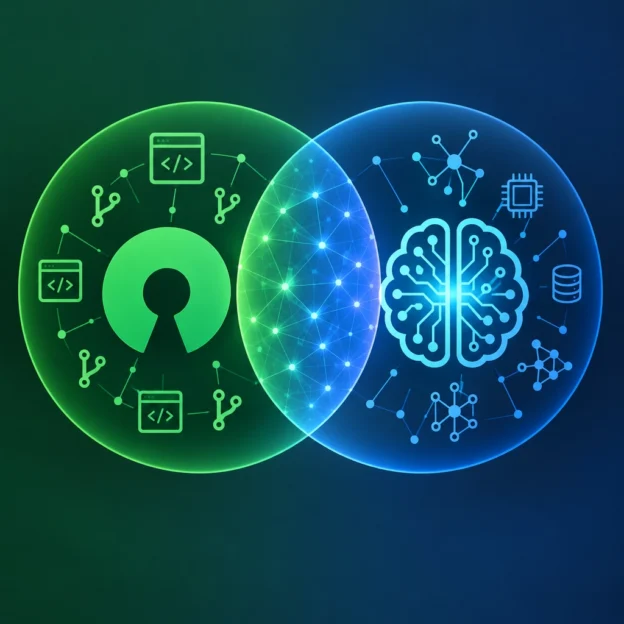
The Intersection of Open Source and Artificial Intelligence
Artificial intelligence can feel like a locked room: powerful tools on one side, a small group of companies holding the keys on the other. Open source offers another possibility. By making code, models, and research available for others to inspect and build on, it can broaden who gets to shape AI—and what AI is used for.
But the relationship between open source and AI isn’t as simple as “more openness is always better.” AI systems are more than lines of code, and sharing them brings both real opportunities and real risks.
What does “open source” mean in AI?
In traditional software, open source usually means that people can view, use, modify, and distribute a program’s source code under a license. With AI, the picture is more complicated. A system may include its code, model weights, training data, documentation, and instructions for running it. These pieces may be shared under different terms—or not shared at all.
That’s why an AI model described as “open” may still be difficult to reproduce or adapt. Its weights might be available, for example, while its training data and methods remain private. Openness is better understood as a spectrum than a switch.
Why open AI matters
The clearest benefit is access. Researchers, startups, nonprofits, and independent developers can experiment with models without building everything from scratch or relying entirely on a handful of large providers. A small team might adapt a model for a local language, a specialized industry, or a tool that works offline.
Open models can also make AI more transparent. Researchers can examine how a system behaves, test its weaknesses, and compare its performance with alternatives. That scrutiny doesn’t guarantee a model is safe or fair, but it creates more opportunities to find problems than a system hidden entirely behind an interface.
There’s a practical advantage, too: shared work can move the field forward faster. Developers can reuse techniques, improve existing tools, and learn from one another rather than repeatedly solving the same problems. Open-source communities have long shown how collaboration can produce reliable software; AI is now testing how far that model can stretch.
The risks of making powerful models available
Greater access also means greater responsibility. A model that can help identify security vulnerabilities or generate persuasive text may be useful to defenders, educators, and creators—but it could also be misused. Once a capable model is widely distributed, it may be difficult to limit who uses it or how.
There are risks even when intentions are good. Open models can reproduce biases found in their training data. They may provide inaccurate answers with confidence, expose sensitive information, or perform poorly for people and communities that were underrepresented in development. Publishing a model without clear documentation can make these problems harder to spot.
And “open” doesn’t automatically mean accountable. If a model causes harm, responsibility may be spread among its creators, distributors, deployers, and users. A download link alone doesn’t provide guidance on testing, monitoring, or responding to problems.
Finding a workable balance
The debate shouldn’t be reduced to choosing between total openness and total secrecy. Different models and uses carry different levels of risk. A small model designed to summarize public documents may call for a different release strategy than a system with capabilities that could enable serious harm.
Responsible sharing can include detailed documentation, clear licenses, safety evaluations, and information about a model’s limitations. Developers can also release models in stages, provide access to higher-risk capabilities under controlled conditions, or support independent testing before wider distribution.
Just as important, open AI should involve more than releasing technical assets. Communities affected by a model’s use should have a say in how it is designed and deployed. Researchers, users, and public-interest groups can help surface concerns that developers alone might miss.
An ongoing conversation
Open source has helped make technology more collaborative, adaptable, and accessible. In AI, it can do the same—but only if openness is paired with care. Sharing models can distribute opportunity, while thoughtful safeguards and honest documentation can help reduce the chance that those tools cause harm.
The most useful question isn’t simply, “Is this AI open?” It’s “What has been made open, who benefits, who might be affected, and what responsibilities come with sharing it?” The answers will shape whether open AI becomes a resource people can trust and improve—or just another powerful technology released without enough thought about what happens next.