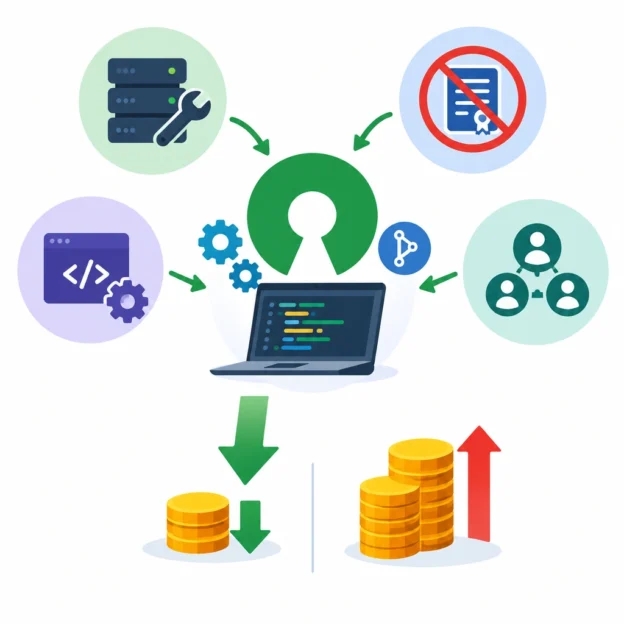
How Open Source Software Can Reduce Operational Costs
Technology costs can sneak up on a business. Licensing fees, infrastructure bills, support contracts, and upgrades may each seem manageable on their own, but together they can take a substantial bite out of the budget. Open source software offers one way to keep those expenses in check—not by making technology free in every sense, but by giving organizations more choices about how they buy, use, and maintain it.
Open source software is built around publicly available source code that users can inspect, modify, and share under the terms of a license. Popular examples include Linux, PostgreSQL, and Kubernetes. Many organizations use open source tools alongside commercial products, while others build much of their technology stack with them.
Lower licensing costs
The most immediate potential savings come from software licensing. Many open source applications can be used without paying a per-user or per-server license fee. That can make a significant difference as a company grows: adding employees or expanding a service may not trigger the same jump in software costs.
Consider a business that needs a database for a growing application. A commercial database might charge based on processor capacity, users, or other usage measures. An open source option may avoid those license charges, leaving the company with more room in its budget.
Still, “no license fee” doesn’t mean “no cost.” A business may spend money on installation, hosting, customization, training, security, and support. The useful comparison is the total cost of ownership—not just the price listed on a vendor’s invoice.
More control over infrastructure
Open source tools can give organizations flexibility in where and how they run their systems. Depending on the software and the organization’s needs, it may be possible to run a workload in a public cloud, on a company’s own servers, or in a hybrid environment.
That flexibility can help businesses avoid relying too heavily on one provider’s pricing or platform. If costs rise or requirements change, teams may have more options to move, adjust, or replace parts of their systems. Open standards and widely used tools can also make it easier to connect different products without paying for a single vendor’s complete ecosystem.
The savings aren’t automatic, though. Moving applications between platforms takes planning, and poorly managed infrastructure can become expensive regardless of the software used.
Extending the life of existing technology
Organizations don’t always need to replace a system to improve it. Open source software may help teams maintain older applications, automate routine tasks, or add useful features without purchasing a new, all-in-one product.
For example, a small operations team might use open source monitoring tools to track system health and spot problems sooner. Catching a failing service early can reduce downtime, emergency work, and lost sales. In this case, the financial benefit comes not only from avoiding license fees, but from running the business more efficiently.
A large community can be another asset. Users share documentation, tutorials, and solutions to common problems, which may help teams resolve issues without immediately turning to paid consultants. For critical systems, however, community resources may not replace the predictable response times or accountability of a professional support agreement.
Avoiding expensive vendor lock-in
With some proprietary platforms, switching providers can be difficult because data, workflows, or applications are closely tied to one vendor’s tools. That dependency can limit negotiating power and make future changes costly.
Open source software can reduce this risk when it uses open formats and interfaces. Teams may be able to adapt the code, choose a different service provider, or bring support in-house. This doesn’t eliminate every switching cost, but it can give businesses more leverage and reduce the chance that a single supplier dictates the terms.
Budget for people, security, and support
Open source works best when organizations treat it as a long-term operational choice, not a shortcut to free technology. Teams still need someone to evaluate software licenses, apply security updates, manage backups, and monitor performance. Some projects offer commercial support, while others rely more heavily on community-maintained resources.
A sensible first step is to choose a well-established tool for a specific need, then estimate all related costs: staff time, hosting, migration, training, maintenance, and support. A small pilot can reveal whether the software fits the team’s skills and existing systems before it becomes part of a critical workflow.
Open source software can reduce operational costs by lowering licensing expenses, increasing flexibility, and helping teams make more of the technology they already have. Its greatest value, however, comes from having choices. When organizations weigh the full costs and invest in the skills to manage their tools well, open source can be less a bargain-bin alternative and more a practical foundation for sustainable operations.