How Open Source Communities Drive Software Development
Much of the software we use every day—from web browsers and mobile apps to cloud services—has been shaped by open source. But open source is more than code anyone can inspect or download. It’s a way of working in which people collaborate across organizations and borders to build, improve, and maintain software together.
At the center of that work is the community.
More perspectives, better solutions
A traditional software team usually works within one company, with a defined set of customers and priorities. An open source project can bring together developers, designers, researchers, businesses, and everyday users from around the world. Each contributor sees the software from a different angle.
That variety can uncover problems a small team might miss. A user may spot an accessibility issue. A developer may identify a security weakness. Someone working in a different country may notice that an interface or feature doesn’t work well for local needs. When people can report issues and suggest improvements, software can respond to a wider range of real-world experiences.
Contributors also bring different technical skills. One person might improve performance, while another writes documentation or tests. Not every valuable contribution involves writing code.
Collaboration turns ideas into usable tools
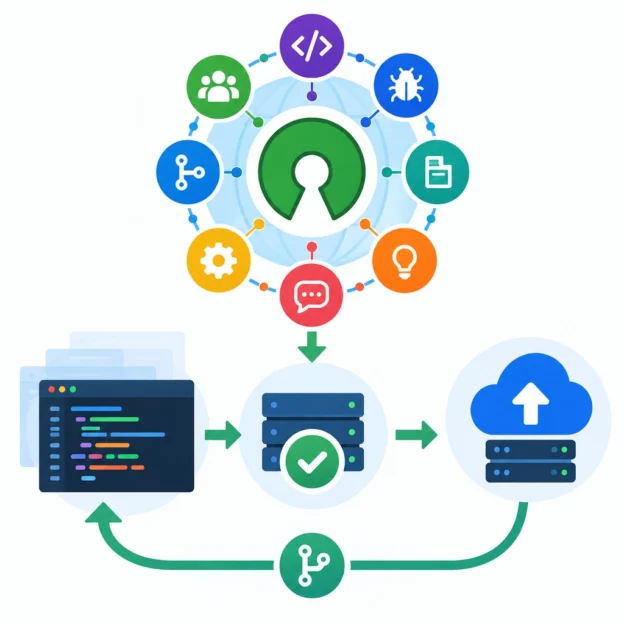
Open source communities provide a place for people to propose changes, ask questions, and work through disagreements. A contributor might open a discussion about a feature, submit a code change, or report a bug. Project maintainers and other participants review the work, suggest revisions, and decide whether it fits the project.
This process can make development more transparent. Decisions and discussions often happen in public, so others can understand why a change was made—or why it wasn’t. That history helps new contributors learn the project and gives users a clearer picture of how the software is evolving.
Review matters, too. When several people examine a proposed change, they may catch mistakes, question assumptions, or suggest a simpler approach. It doesn’t guarantee flawless software, but it creates opportunities for careful scrutiny that go beyond one person’s judgment.
Shared ownership can speed up development
When a project has an active community, its original creators don’t have to do everything themselves. Contributors can fix bugs, build integrations, improve documentation, and develop features that the core team may not have time to prioritize.
This shared effort can help software move forward faster. It can also make tools more adaptable: users can modify open source software for their own needs, and those improvements may later benefit the wider community. A fix created for one organization, for example, could become a feature that helps thousands of others.
Companies benefit from this model as well. They can build on open source tools rather than starting from scratch, and they can contribute improvements back. In practice, modern software often depends on many open source projects, maintained by a mix of volunteers, nonprofits, universities, and businesses.
Healthy communities need care
Open source isn’t automatically collaborative just because the code is public. Projects need people who answer questions, review contributions, maintain releases, and help newcomers find their footing. These tasks take time, and much of this work can be invisible.
Communities also need clear guidelines for participation, respectful communication, and a fair process for making decisions. Without those basics, newcomers may feel unwelcome, discussions can become difficult, and a few exhausted maintainers may end up carrying too much responsibility.
Sustainability is another challenge. A widely used project may depend on maintainers who are volunteering in their spare time. When companies rely on open source software, supporting the people and organizations behind it—through funding, engineering time, or other resources—can help keep essential projects healthy.
A different way to build software
Open source communities have changed software development by making collaboration a central part of the process. They create room for people to share expertise, question existing approaches, and build tools that no single team might have created alone.
The strongest projects aren’t simply collections of code. They’re communities that make it possible for people to contribute, learn, and take responsibility together. When that collaboration is supported and sustained, software becomes more than a product—it becomes a shared resource that can keep growing with the people who use it.